On the Notwithstanding Clause and the Judicial Role (Responses to Coyne on X)

The Notwithstanding Clause has been much in the news again lately. Andrew Coyne, a prominent Canadian pundit (for whom I have a lot of time), has consistently opposed expanded use of the Clause. In at least two recent X posts, one last month and another yesterday, Coyne observed that judicial fallibility cannot justify greater resort to section 33. Here is the first:
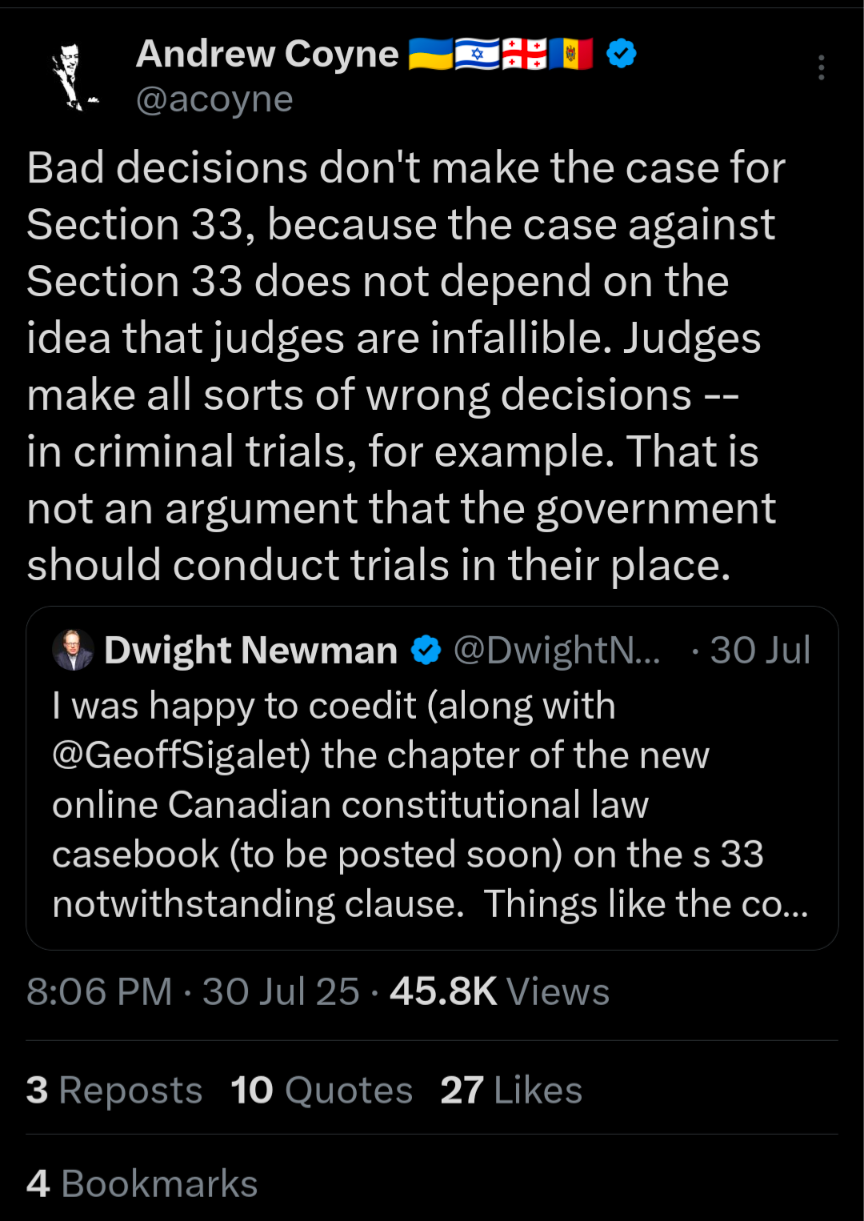
My initial response accepted that the mere fact of fallibility cannot justify sweeping away judicial supremacy. That concession, however, is followed by a lot of buts:
That's true. What makes the case for s 33 is (a) the fact that *someone* ultimately must decide; (b) that in a democratic society, that someone is presumptively the elected body; (c) that questions of constitutionality involve inherently contested questions of value that judges are not more qualified to decide than legislatures; (d) that (at the appellate level at least) these questions of value are themselves decided by a majority vote, albeit a vote of 3, 5, or 9; (e) that legislatures are institutionally superior to courts in determining the conditions under which laws will be imposed and applied; (f) that the actual way in which our courts resolve questions of constitutionality show insufficient deference to elected bodies, often warping and distorting irreducibly moral arguments in an attempt to package them as suitably "legal", and tend not to recognize the value of history or tradition; and (g) that it is a simple fact that s 33 exists, that the Charter would not exist without it, and that it fits nicely within a longer constitutional tradition of legislative supremacy - meaning that there should be no need to make a special *case* for it at all.
After this initial response, Andrew was kind enough to provide excerpts from his new book, in which he makes an extended case against section 33.
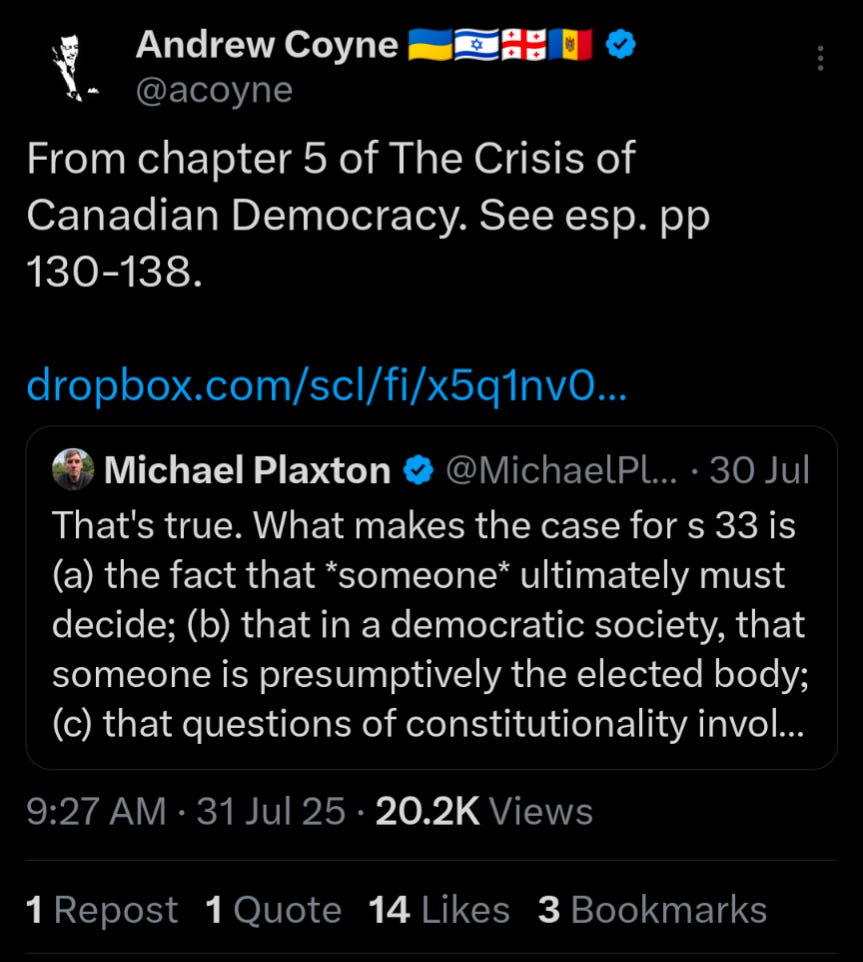
(I have since bought it.) I thought that such a kind gesture deserved a response, and offered one in a thread on X:
It is very kind of you to post a chunk of your book - which I have just ordered and look forward to reading in full. I have some thoughts, though I don't think I am going to convince you.
1. Your argument very much depends on the presupposition that there is nothing basically, structurally unsound about the SCC's whole approach to Charter adjudication - to, say, the Oakes test for section 1; or the Court's understanding of section 7. If there is, then it isn't a question of the odd wrong decision here and there, but of an entire edifice sitting on shaky foundations.
The Oakes test, for example, is not as solid or reliable as you make out. It has actually changed over time (compare Oakes itself to Hutterian Brethren). Indeed, according to how we now understand the rational connection test, it was not applied properly in Oakes itself!
Moreover, the soundness of the Oakes test is hotly disputed by constitutional thinkers (eg, by @GregoireWebber) who argue that it distorts the entire way we think about rights.
The Court's section 7 analysis is arguably deeply problematic. Start with BC Motor Vehicle Reference: it is not at all obvious that section 7 confers substantive (as opposed to procedural) rights to anything, yet we are now locked into that sweeping position. What test to apply to determine whether a given proposition counts as a principle of fundamental justice has changed significantly over time. The grounds of instrumental rationality - in particular, overbreadth and gross disproportionally - are not at all obvious, allowing sweeping review of legislative activity under circumstances where common sense would suggest there is no right engaged in the first place.
These are not isolated issues. They are pervasive and structural. One could not "fix" them without completely overhauling the entire body of Charter jurisprudence - basically starting over. On any understanding of the law of precedent, it is an impossibly heavy lift convincing judges to undo it.
I want to stress the structural problem, because it shows that it is a mistake to ask if there are occasional wrong decisions. The whole footing on which Charter decisions are done is arguably problematic. And of course this has knock-on effects: legislatures and other legal decision-makers will skew their laws to make them compliant with a body of case authorities and Charter doctrines ("Charterproofing"). The decision to appeal will be impacted by the perception that it will be fruitless. With that in mind, it is not even possible to rely on empirical/statistical studies of "who wins" in Charter cases. The Court, one might say, always wins.
Consider too questions of standing and justiciability - which are both sweeping and emphasize the Court's role as a lawmaker rather than a mere adjudicative body. This has had an enormous effect on both who can challenge laws but also how those challenges are dealt with (eg, the use of reasonable hypotheticals in s 12 cases).
Again, structural not isolated controversies that call into question more than this or that case or doctrine.
2. I want to also emphasize that the Court cannot avoid making controversial moves. You say that the Court should not read things into the Charter that aren't there. Impossible. Constitutional rights provisions are intrinsically open-ended and fuzzy in their language, and that these need to be given content if they are to have any solidity at all. Justice Scalia knew that. But that underscores the impossibility of having strong-form judicial review that doesn't depend on courts making big choices. The question is how they should fill in the gaps.
Here, it is clear that the Court's gap-filling process displays a strong preference for some resources over others. In particular, history and tradition have gotten short shrift, and various political philosophies have assumed great importance over others.
Again, one makes a mistake to think that one could fix that in ways that wouldn't resound and ricochet throughout the entire constitutional system.
3. This isn't an attack on the Charter as such. But one could make such an attack, which is why one shouldn't dismiss the idea that, if it's a choice between the Charter and s 33, the Charter should prevail. You're right that the decision to enact the Charter was a decision to do something, and normalizing s 33 risks undoing that something. But we may see the decision as a gambit: "we will take the chance that s 33 will swallow the Charter for the opportunity or possibility that it won't. We'll wait and see how it all plays out, and we're still better off getting the possibility of something than the guarantee of nothing."
Well, we've waited and we've seen...
4. Like others, I admit I find the appeal to the disallowance power a bit odd. Not that I necessarily disagree with your take on desuetude. I just find the idea that it is less controversial than the NWC unconvincing. I could turn your point about the basic incompatibility of the NWC and Charter around: "you can have real federalism or you can have the disallowance power, but you can't have both."
5. In the end, I feel like your whole argument depends on an unstated constitutional theory. You want to say that there are some decisions that must be pulled out of the ordinary cut and thrust of politics. Fine. You're not alone. But you don't say what that theory is, so you can't say what the Court got wrong and what it didn't. So you effectively adopt a kind of conventionalism stance that most of what the SCC has done is basically right, and we don't want to lose it. But as I've tried to argue here, it isn't obvious that most of what the Court has done is basically right, or that we could fix it if it's not.
So there we are. I am going to set aside some of your more ungenerous assumptions about the people who support s 33. I obviously think there's more going on than that.
Thanks again for providing the sections of your book. I do look forward to reading the rest.
That was the end of it until yesterday, when Andrew returned to the fallibility point.
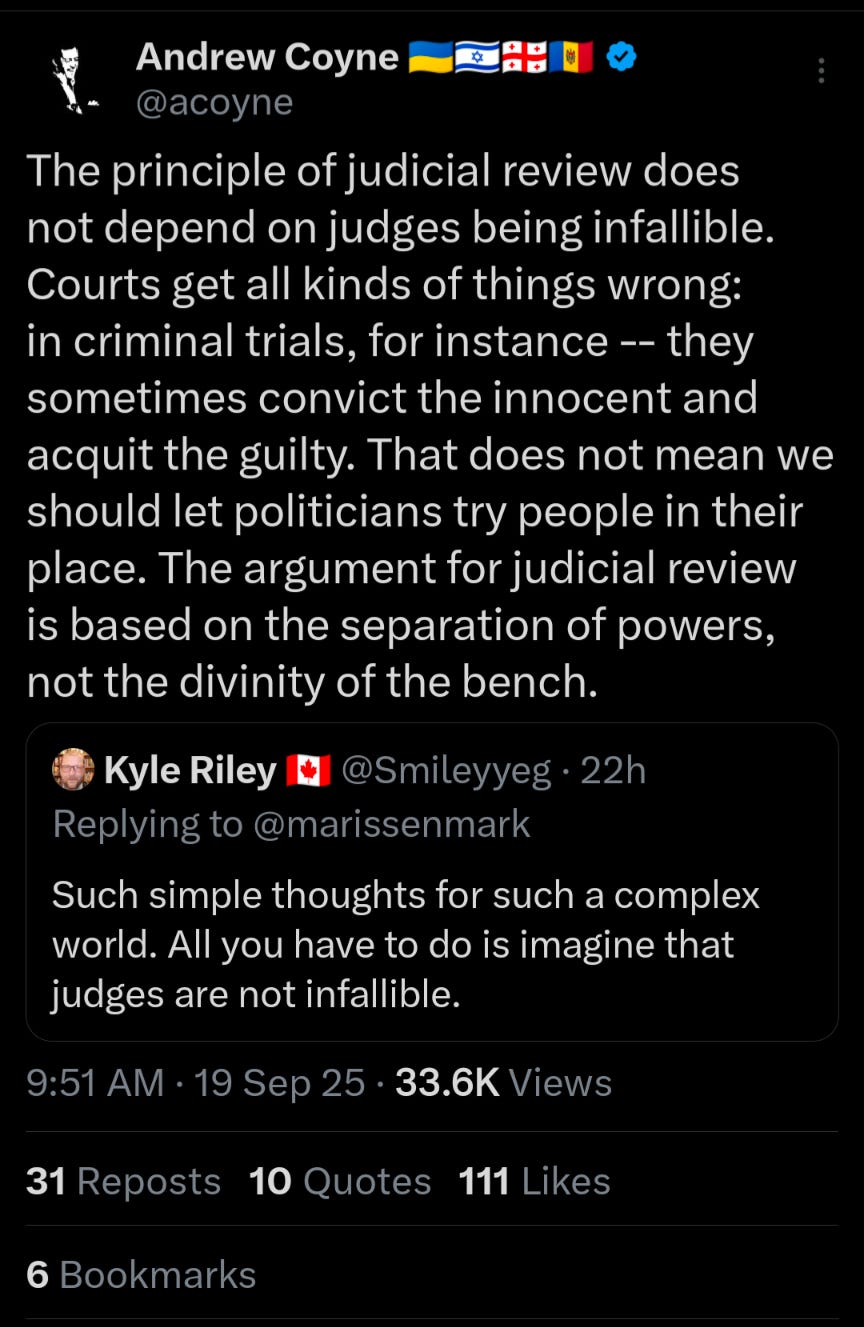
My response to this most recent tweet was somewhat more involved than my original one, and this time focuses on the slipperiness in Andrew's use of the criminal trial:
With the greatest respect, this argument is weak and misleading - and in fact depends on playing a kind of shell game with what it means to talk about the "adjudicative" function.
In the example you give, a criminal trial by judge alone, the judge's role is straightforwardly adjudicative - it involves making fact findings, based on evidence, about whether the Crown's allegations concerning what *this defendant* did are true, untrue, or insufficiently proven. Typically, the elements of the offence, and what the Crown must prove by way of satisfying them, will have already been established long before the trial. The judge's role in the trial is relatively passive; the judge makes evidentiary rulings along the way, but by and large leaves it to the parties to frame the factual dispute. This is the least controversial role for judges on any picture of the judicial role and adjudicative function.
This bears virtually no relation to what appellate court judges do in Charter cases in which they "interpret" Charter rights. That interpretation is not evidence-driven - how could it be, since it rests on unprovable premises about morality, political morality, values, normative claims about the significance of history and tradition, and much more? The judges in such cases are not passive umpires, adjudicating factual disputes - they are acting as *law-makers* and, importantly, are purporting to define the limits of *other* branches of government.
Insofar as they are not purporting to interpret the right themselves, but merely to apply existing constitutional doctrine, the inquiry becomes more evidence-driven. But even here, in the section 1 or 7 or 15 context, it is altogether misleading to suggest that judges are engaged in anything like "adjudication" in the manner of the criminal trial judge. There is more leeway for judges in this context to make use of judicial notice - fact-finding without evidence - and to take an active role in framing the constitutional dispute.
In short, the judge's role, here, is more aptly described as "legislative" or even "super-legislative". So separation of powers considerations actually may suggest that judges have no superior claim to deciding the sorts of questions that arise in Charter cases. Certainly, there is little or no reason to think that their legal training makes them more qualified to decide questions of morality, political morality, values, etc; or to decide what social facts exist insofar as the evidence is in wide dispute. They are not better placed than, say, a parliamentary committee.
Keep in mind, too, that the judicial power in other jurisdictions (US; UK) is recognized as much narrower than it is here - precisely because it is understood that courts stretch their credibility insofar as they stray beyond a narrow adjudicative role.
Pretending that everything that judges do in Canada is "adjudicative" in a non-controversial sense is, I'm sorry, deeply misleading.
Also, pretending that only cranks would call into question the legitimacy of judicial supremacy is wrong and distorting: Jeremy Waldron, one of the world's great thinkers on judicial review, made a case against it more than two decades ago, and even if one disagrees with some of it, it cannot be ignored or dismissed by anyone in good faith.
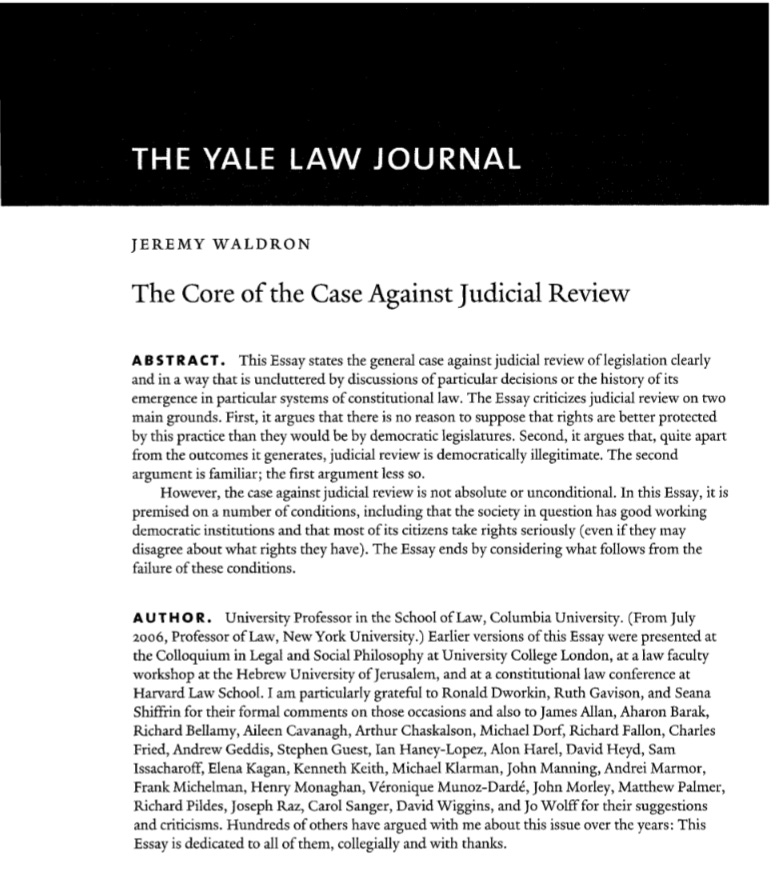
I would also note that the marked distinction between what a trial judge does in a quotidian criminal case, and what an appellate judge does, was emphasized by Justice Sharpe - no radical - in his book, Good Judgement.
That, then, is where matters presently stand. Exciting times…